









What should the pressure be in a car air conditioning system?
What should the pressure be in a car air conditioning system?
This is a common question among drivers who notice that their air conditioning cools poorly or operates unevenly when turned on. In practice, there is no single value that fits every car, as the pressure in automotive air conditioning depends on the car model, refrigerant type, ambient temperature, and system load. Nevertheless, an approximate standard can be identified to help determine whether the air conditioning system is working properly.
In a properly filled air conditioning system, low-side pressure values usually fall within the range of about 2–3 bar, while high-side pressure is most often around 10–16 bar, and even higher during hot weather. However, such readings change along with operating conditions, which is why air conditioning system pressure is always evaluated based on measurement conditions rather than a single number.
What does pressure in a car air conditioning system depend on?
The most important thing to know is that pressure is not constant. It depends on temperature, engine operation, RPM speed, ventilation performance, and the amount of heat the system needs to extract. That is precisely why, after switching on the AC, different values appear at idle compared to when driving. The quantity of refrigerant circulating in the car’s air conditioning system also holds significance, as does the efficiency of components such as the compressor, evaporator, and condenser.
Simply put, the whole process relies on the principle of refrigerant circulation. The refrigerant absorbs heat from inside the car, moves to the compressor where pressure increases, and then releases the heat outside through the condenser. Afterwards, it returns to circulation, cools the cabin air, and begins the cycle again. This operating method means system pressure must always be analyzed alongside the overall circulation performance.
How to read the correct pressure?
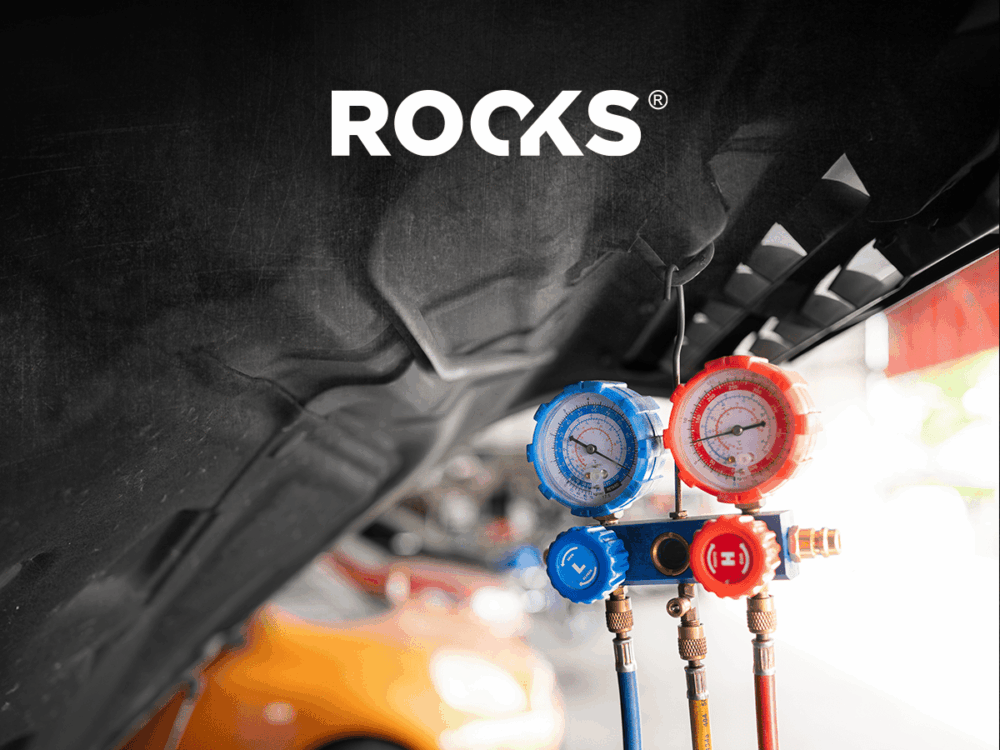
The most precise check is performed using pressure gauges. These display readings on both the low-pressure side and the high-pressure side. Under typical conditions with the air conditioning running, low-side values are usually around 2–3 bar, while high pressure is most often around 10–16 bar. When the outdoor temperature rises, high-side values may increase because the system works harder to dissipate heat.
It is worth remembering that at rest—when parked with the AC off—pressure within the system typically equalizes. At that point, it may read around 5–6 bar on both sides, though this also depends on ambient temperature and gas type. Therefore, a single static pressure check while parked is not enough to assess system health. A comparison is needed to see how the system operates when activated and how the compressor, fan, and control sensors respond.
If low-side values are too low, it may indicate a lack of refrigerant, an expansion issue, or restricted flow through the evaporator. Conversely, excessively high pressure on the discharge side often points to poor cooling at the condenser, a faulty fan, a dirty radiator, or overfilled refrigerant. In both cases, efficiency drops, and continued driving can lead to severe component damage and expensive repairs.
What do abnormal readings mean?
If air conditioning system pressure is too low, the cause may be insufficient refrigerant volume, a leak, or a problem with compressor operation. In such cases, the AC cools weakly, and the engine may engage the compressor clutch more frequently under load. When excessively high pressure occurs, you should check whether the condenser is dirty, whether the fan is functioning properly, if there is an overabundance of refrigerant in circulation, or if moisture has entered the system.
Oil is also important because it lubricates compressor components alongside the refrigerant. If oil levels are too low or the refrigerant circulates improperly, the risk of overheating and compressor damage rises. For this reason, simply recharging the air conditioning without diagnosing the issue does not always solve the problem. Sometimes the root cause involves not just fluid volume, but circulation quality, overall system condition, radiator cleanliness, and engine performance.
When to visit a service shop and how to evaluate results?
If you wonder whether a reading falls within normal limits, it is best to compare it against the vehicle’s operating conditions. For one model, 12 bar on the high side might be completely fine, while for another under high temperatures, it could be too low or too high. That is why not only raw pressure counts, but also how quickly cooling engages and how cold the air is coming from the vents.
When car air conditioning is accompanied by weak cooling, erratic performance, or frequent shut-offs, visiting a service center is recommended. A technician will perform an inspection, evaluate system pressure, check refrigerant condition and volume, confirm proper oil circulation, and verify that the correct amount of refrigerant is present. Only then can you get a reliable answer regarding what the correct pressure should be for a given car and whether the AC is truly working as it should.
